Pre-seed open ·  R1 chain proof ≤30 days · the 500-hour record in Q1

Earth. At full power. At $30–45 a megawatt-hour.

Geothermal is the only energy source that is firm and everywhere. The constraint is cost — and the instruments to earn it. Zemanium builds the measurement and qualification layer of superhot rock: the instrument superhot wells die without, and the yardstick the category will be graded on.

Start a conversation See what exists today
01 — Proof

What exists today is built, run and audited. And every number is labeled.

Deep tech earns belief with artifacts. Ours are in hand: a working readout engine and digital furnace with 47 pre-registered contracts green, five invention campaigns judged by their real bench gate checkers, full CAD and manufacturing drawings, and a cost model whose arithmetic was recomputed from the stored physical trajectories and published.

Then the honest line, printed because diligence will find it anyway: zero hardware duty hours measured so far. Design, software, digital qualification and audited economics are done — the round converts them into measurements. Analysis alone cannot qualify hardware. We say that out loud because it is the standard we intend to sell.

5 / 5
inventions virtually qualified against their bench gates — 56 contracts green simulated
47
pre-registered contracts green on the Cool-Brain digital furnace
34
verified claims in the tool-stack teardown — corrections published
02 — The gap

The industry drills hotter than it can see.

Superhot wells die at transients. Across the 20-well supercritical base rate, failures are dominated by thermal stress at quench and kick-off — the hours nobody has instrumented.

Capital reached the frontier anyway: Quaise $180M, Mazama $135M, Hephae $17.8M, Fervo's Cape Station first power — one quarter, all verified. Meanwhile the working tool stack tops out near 200 °C for 150–200-hour-class duty, and the celebrated 350 °C tools are survival ratings for four-hour logging runs. Every rating on the market is a survival number. None is a duty record.
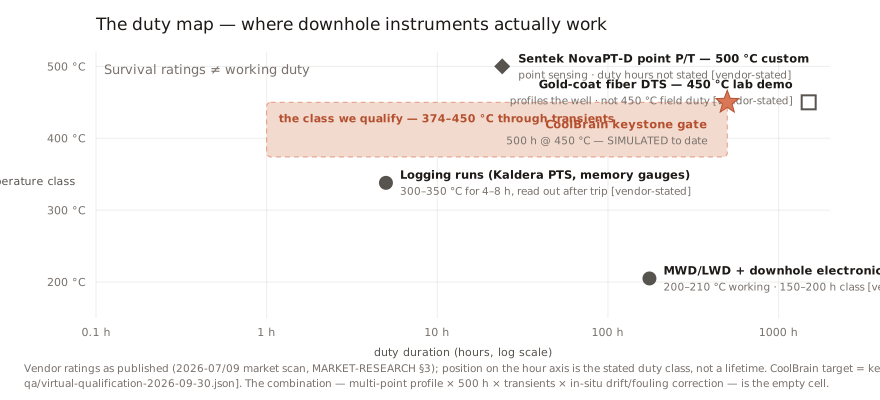
Duty map: working temperature versus working duration for downhole instrument classes
The duty map. Above 375 °C there is no qualification service and no test standard — the 500-hour cell at 450 °C is empty. That cell is the company.
03 — Position

The sensor is the product. The yardstick is the company.

ARPA-E funded three superhot categories — well construction, heat extraction, and testing, validation and quality-assurance infrastructure. The third has no occupant. We are occupying it.

Cool-Brain ships with the qualification basis — duty classes, test taxonomy, a witnessed-report contract — and the first witnessed 500-hour record at 450 °C: entry number one in our own standard. A developer qualifying its own tools convinces nobody; the majors are slow and conflicted. The referee position is empty. Whichever developer wins the superhot race, the category grades on our yardstick — and adoption is a sale, not a loss.

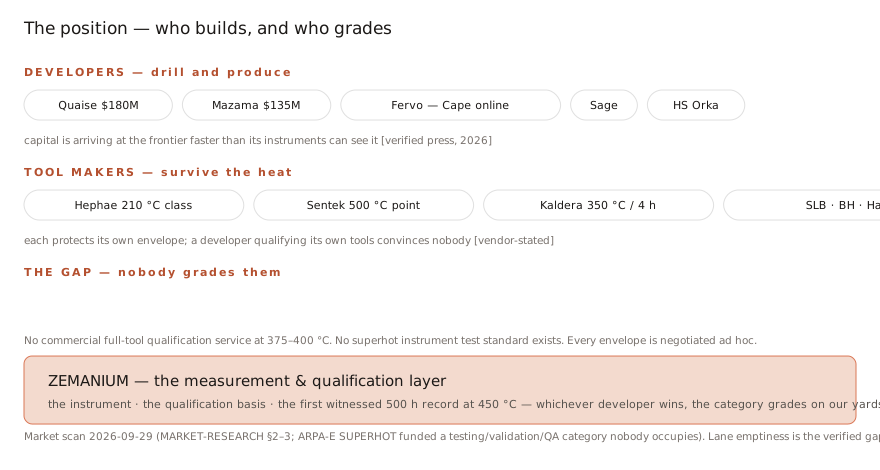
Category map: developers, tool makers and the qualification layer
Who builds, who grades. Claim surfaces filed before contact, measured maps no paper contains, and the operating record that compounds with every installed machine.
04 — Platform

One instrument. Five inventions. Three product lines.

Cool-Brain keeps every active component below 100 °C while a passive Inconel waveguide measures 450 °C-class temperatures at five points — correcting the drift and fouling that kill downhole instruments, in place, in the well.

Behind it, the series that carries economics down the ladder: E1 Shift-Latch reroutes the reservoir on command (window 54–137.6 µm simulated); E2 Clear-Chemistry keeps the hot branch conductive (three chemistry classes pass); E3 Conversion takes the installed power block to ≤$1,000/gross-kW (a $367/kW gap, named and scoped); E4 Ember-BHCT drills hotter with a managed bottomhole temperature; E5 Flex-Seal lets the well survive 25 years of transients. In the field, the products: Relay commands the heat, Shift reroutes the reservoir, Flex survives the cycling.

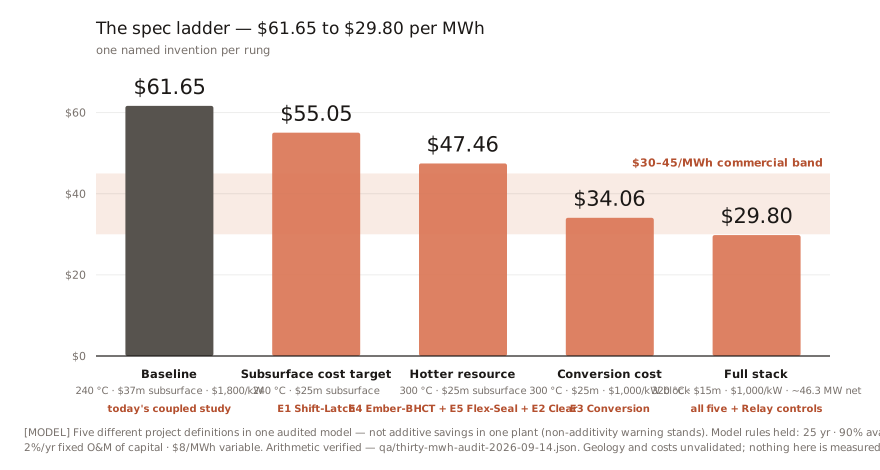
LCOE spec ladder from 61.65 to 29.80 dollars per MWh
The spec ladder — different project definitions in one audited model, each transition naming the invention that must deliver it model.
05 — Method

Test before metal. Publish the kill conditions. Correct the record.

Every invention runs a full virtual qualification campaign before any hardware: physics simulation, Monte Carlo, pre-registered falsifiers, and gates identical to the bench gates — judged by the same gate-checker code the bench will use.

Five mechanisms have run their campaigns: 56 contracts green, every gate and falsifier executed simulated. The E1 release latch passes its real decision rule in 95.8% of virtual campaigns. Each campaign emits its damage ranking — the bench's measurement priority list. Failure is informative and published: attenuation maps and leak modes become named redesign levers.

And the brand underneath the brand: every number keeps its label — verified, simulated, assumption, TBD — and corrections go in the open record. We corrected the field's phantom "45–50 MW target"; we corrected our own datasheet pair and re-published it. Confidence in the delivery; evidence in the claim.

06 — The model, running

Our film is not a film. It is the model, live.

The digital furnace, the echo chain and the reservoir response engine run in the browser. Watch the corrected readout hold its gate while the naive one drifts — then attack the parameters yourself.

Simulation is our design authority and our pre-registration. Show it live beats show it polished.

Open the live model
07 — Ambition

Three numbers this quarter. Then gigawatts in metal.

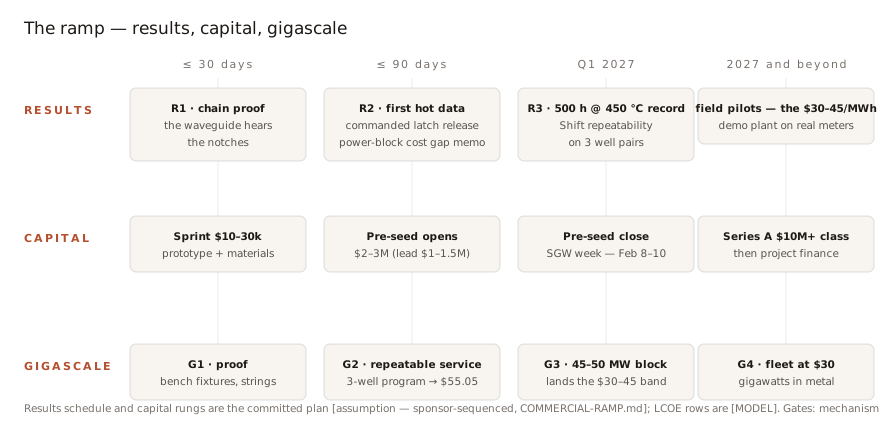
R1: the chain proof within 30 days. R2: first hot data with deliberate drift and fouling attacks within 90. R3: the segment's first witnessed 500-hour qualification record at 450 °C in Q1 — presented at Stanford's superhot workshop in February.

Then the physical ladder: a three-well design-partner program proving repeatable service, the first 45–50 MW block landing the $30–45 band, and a fleet at $30/MWh whose 25-year operating records compound the moat. By the fleet rung we manufacture the power-block modules, the strings and the qualification services. Think in gigawatts. Build in metal. Design the first machine for the next thousand.

Ramp: results schedule, capital ladder and gigascale rungs
Results → capital → gigascale. The schedule is the committed plan plan; the cost rows are model.
08 — Team & talent

Put your name on the next energy giant.

One founder today: a self-taught engineer who co-founded and shipped a data platform in mining — the harder, dirtier industry — then built this field's first adversarially-verified evidence base, corrected its folklore in public, reduced the instrument to practice, and wrote the qualification basis the segment never had.

Four founding seats are open: ultrasonics & acoustics — own the waveguide and the DSP. High-temperature packaging & mechanical — own the tool that survives the trip. Qualification & test — own the yardstick and the witnessed record. Drilling-operations advisor — own the field reality check. Founding equity, and named artifacts: your name on the paper and on the qualification record. This is a defining piece of work to own, not a role to fill.

09 — Questions

The five questions diligence always asks.

Is any of this measured?+

Not on hardware yet — and every performance figure is labeled simulated for exactly that reason. The chain proof lands within 30 days, first hot data within 90, the 500-hour record in Q1. Sims are our design authority; gates close on measurements (IEEE-323 discipline).

Who else is doing this?+

Named, in the same breath: Sentek (500 °C point sensing), Kaldera and the memory-gauge houses (350 °C for hours), fiber DTS (300–450 °C in the lab), Hephae (210 °C-class active tools). The combination — profile × duration × transient × calibration × duty — exists nowhere else.

Why you?+

The claim surface is designed around the prior art and filed before contact; the evidence base is the field's only adversarially verified one; the qualification basis is drafted and circulating. The position does not need permission — it needs the record, and the record is scheduled.

What breaks first?+

We publish our kill conditions before testing (the E1 falsifiers F1–F5 are in the dossier). If a gate fails, the failure is a named redesign lever and a published result — that is what a qualification company's failure looks like.

What does the money do?+

Named milestones, never runway: R1→R3 numbers, the Rev B field string, design-partner wells, first commercial subsystems, the qualification service in revenue.

The $2–3M pre-seed is open (lead $1–1.5M) against a dated results schedule. Operators get design-partner conversations now. Engineers get founding seats. Labs get co-authorship and the yardstick.